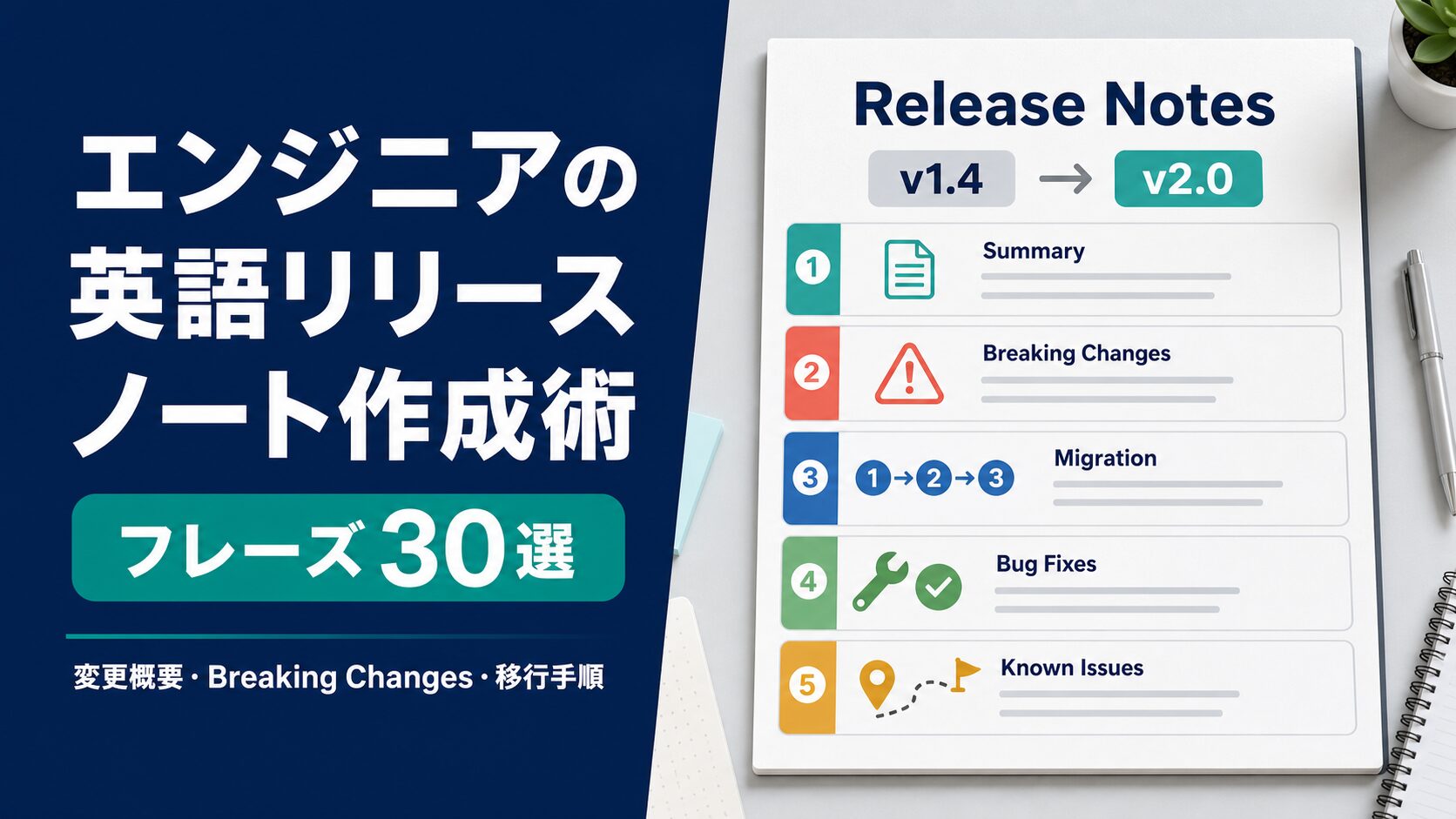
リリースノートを英語で書こうとしたとき、何をどう書けばいいかわからなくて手が止まる。Breaking Changesをどう表現すれば伝わるのか、移行手順をどう説明すれば読み手が動けるのか——そんな経験を持つエンジニアは多い。
英語リリースノートはバージョン管理の記録であるだけでなく、ユーザーや開発チームへの「告知文」でもある。変更の影響度・対応の要否・移行のタイミングを明確に伝えることが、ユーザーのトラブルを防ぎ、チームの混乱をなくす。
この記事では、英語リリースノートで使えるフレーズ30選を5つのシーン別に解説する。変更概要からBreaking Changes・移行手順・バグ修正・今後の予定まで、GitHubのリリースページやCHANGELOGにそのまま使えるパターンを中心に紹介する。
フレーズを型として持っておくことで、リリースのたびにゼロから文章を考える手間がなくなる。
シーン1:変更概要を書く(Change Summary)
リリースノートの冒頭に書く「このバージョンで何が変わったか」の概要は、読み手が最初に目にする部分だ。簡潔に変更の規模と方向性を伝えることで、詳細を読むかどうかの判断材料になる。
使えるフレーズ6選
バージョンと変更の規模を宣言する
"We are releasing version [X.Y.Z], which includes [N] new features, [N] improvements, and [N] bug fixes."
(バージョン[X.Y.Z]をリリースします。[N]件の新機能、[N]件の改善、[N]件のバグ修正が含まれます。)

"This is a [major/minor/patch] release that introduces [brief description of key change]."
(これは[major/minor/patch]リリースで、[主要な変更の概要]を導入します。)
ハイライトを簡潔にまとめる
"Highlights of this release:
- [Feature A]: [one-line description]
- [Feature B]: [one-line description]
- [Breaking change]: [one-line description]"
(このリリースのハイライト:
- [機能A]:[一行の説明]
- [機能B]:[一行の説明]
- [破壊的変更]:[一行の説明])

"The main goal of this release is to [objective, e.g., improve performance / simplify configuration / address security vulnerabilities]."
(このリリースの主な目的は[目的、例:パフォーマンスの改善・設定の簡素化・セキュリティ脆弱性への対処]です。)
スコープと影響範囲を示す
"This release affects all users of [component/service]. No action is required for users on [other component]."
(このリリースは[コンポーネント/サービス]のすべてのユーザーに影響します。[他のコンポーネント]のユーザーは対応不要です。)

"Users running version [X.Y] or earlier are encouraged to upgrade. See the migration guide below."
(バージョン[X.Y]以前をお使いのユーザーはアップグレードを推奨します。以下の移行ガイドをご参照ください。)
シーン2:Breaking Changesを通知する
Breaking Changesは、既存のコードやワークフローに互換性のない変更が加わることを意味する。「これを読まなかったために壊れた」とならないよう、明確で目立つ形で記述することが重要だ。
使えるフレーズ6選
Breaking Changeを宣言する
"⚠️ BREAKING CHANGE: [Description of the change]. This affects users who [specific condition]."
(⚠️ 破壊的変更:[変更の説明]。これは[特定の条件]のユーザーに影響します。)

"This release contains a breaking change to [API/configuration/behavior]. If you are using [X], you must update your code before upgrading."
(このリリースには[API/設定/動作]に対する破壊的変更が含まれます。[X]を使用している場合は、アップグレード前にコードを更新する必要があります。)
削除・廃止を通知する
"The [function/parameter/endpoint] [name] has been removed. Use [replacement] instead."
([関数/パラメーター/エンドポイント] [名前]は削除されました。代わりに[置換先]を使用してください。)

"[Feature/API] [name] is deprecated in this release and will be removed in version [X.Y]. Please migrate to [alternative] before then."
([機能/API] [名前]はこのリリースで非推奨となり、バージョン[X.Y]で削除されます。それまでに[代替手段]に移行してください。)
変更の理由を添える
"This change was necessary to [reason, e.g., improve security / align with the new standard / remove legacy behavior]."
(この変更は[理由、例:セキュリティの向上・新しい標準への準拠・レガシー動作の削除]のために必要でした。)

"We understand this may require updates on your end. Please refer to the migration guide and reach out if you have questions."
(対応が必要な方にはご不便をおかけします。移行ガイドをご参照いただき、ご不明な点はお問い合わせください。)リリースノートの構成や必須セクションについては、英語リリースノートの書き方|ITプロジェクトで使える日英フォーマット付きでテンプレートとともに解説している。
シーン3:移行手順を説明する(Migration Guide)
Breaking Changesを含むリリースでは、具体的な移行手順を書くことで読み手が「何をすればいいか」を迷わずに済む。ステップ形式で書くと、抜け漏れなく対応を完了してもらいやすい。
使えるフレーズ6選
移行のステップを示す
"To migrate from version [X] to [Y], follow these steps:
1. [Step 1]
2. [Step 2]
3. [Step 3]"
(バージョン[X]から[Y]に移行するには、以下の手順に従ってください:
1. [ステップ1]
2. [ステップ2]
3. [ステップ3])

"Before upgrading, we recommend:
- Taking a backup of [config file / database / data]
- Reviewing the [changelog / API diff] for breaking changes that affect your setup"
(アップグレード前に以下を推奨します:
- [設定ファイル/データベース/データ]のバックアップを取得する
- 自分の環境に影響する破壊的変更の[changelog/API差分]を確認する)
コードの変更例を示す
"Replace the following in your configuration:
Before: [old code/setting]
After: [new code/setting]"
(設定の以下の部分を変更してください:
変更前:[旧コード/設定]
変更後:[新コード/設定])

"If you are using [X], update your imports/dependencies as follows: [specific instruction]."
([X]を使用している場合は、インポート/依存関係を以下のように更新してください:[具体的な手順])
サポートリソースへの誘導
"For a detailed migration guide, see [link]. If you encounter any issues, please open an issue on [GitHub/Jira] or reach out to [support channel]."
(詳細な移行ガイドは[リンク]をご覧ください。問題が発生した場合は、[GitHub/Jira]でイシューを作成するか、[サポートチャンネル]にお問い合わせください。)

"If you need help migrating, our team is available in [Slack channel / discussion forum]. We will do our best to assist you."
(移行のサポートが必要な場合は、[Slackチャンネル/ディスカッションフォーラム]でチームが対応します。できる限りお手伝いします。)
シーン4:バグ修正・改善を記述する(Bug Fixes & Improvements)
バグ修正と機能改善は、リリースノートで最も記述量が多くなるセクションだ。ユーザーが「自分に関係あるか」を素早く判断できるよう、変更内容と影響範囲を一行で明確に書くことが重要だ。
使えるフレーズ6選
バグ修正を記述する
"Fixed an issue where [description of the bug, e.g., the login page would fail to load when cookies were disabled]."
([バグの説明、例:Cookieが無効の場合にログインページが読み込まれない]問題を修正しました。)

"Resolved a race condition in [component] that caused [symptom] under [specific conditions]."
([特定の条件下]で[症状]を引き起こしていた[コンポーネント]の競合状態を解消しました。)
パフォーマンス改善を記述する
"Improved [metric, e.g., query performance / startup time / memory usage] by [X]% for [scenario]."
([シナリオ]において[指標、例:クエリパフォーマンス/起動時間/メモリ使用量]を[X]%改善しました。)

"Optimized [component] to reduce [resource, e.g., CPU usage / network requests / disk I/O] during [operation]."
([操作]中の[リソース、例:CPU使用率/ネットワークリクエスト/ディスクI/O]を削減するため、[コンポーネント]を最適化しました。)
機能改善を記述する
"Enhanced [feature] to support [new capability, e.g., multi-region deployment / dark mode / pagination]."
([機能]を強化し、[新機能、例:マルチリージョンデプロイ/ダークモード/ページネーション]をサポートしました。)

"Updated [dependency/library] from version [X] to [Y] to address [reason, e.g., a security vulnerability / compatibility issues]."
([理由、例:セキュリティ脆弱性/互換性の問題]に対処するため、[依存関係/ライブラリ]をバージョン[X]から[Y]に更新しました。)技術ドキュメントで変更・影響範囲を記述するさらに詳しいフレーズは、英語技術文書に書く表現30選|設計書・仕様書・提案書で差がつく一文の型にまとめている。
シーン5:既知の問題と今後の予定(Known Issues & Roadmap)
「わかっているが今回は直せなかった問題」と「次のリリースで予定していること」を明示することで、ユーザーの不安を軽減し、フィードバックを集めやすくなる。
使えるフレーズ6選
既知の問題を記述する
"Known issue: [Description of the issue]. Workaround: [temporary solution if available]. This will be addressed in version [X.Y]."
(既知の問題:[問題の説明]。回避策:[一時的な解決策(ある場合)]。バージョン[X.Y]で対処予定です。)

"We are aware of an issue with [feature/component] that affects users who [specific condition]. A fix is in progress and will be included in the next patch release."
([特定の条件]のユーザーに影響する[機能/コンポーネント]の問題を把握しています。修正作業中で、次のパッチリリースに含める予定です。)
今後の予定を示す
"In the next release (version [X.Y]), we plan to [planned improvements, e.g., introduce support for X / refactor Y / deprecate Z]."
(次のリリース(バージョン[X.Y])では、[予定の改善、例:Xのサポート導入/Yのリファクタリング/Zの非推奨化]を予定しています。)

"We are actively working on [feature/improvement] and expect to ship it in [timeframe, e.g., Q3 2025 / the next major release]."
([機能/改善]の開発を進めており、[時期、例:2025年Q3/次のメジャーリリース]にリリースする予定です。)
フィードバックを求める
"If you encounter any issues with this release, please report them at [link]. Your feedback helps us improve."
(このリリースで問題が発生した場合は、[リンク]でご報告ください。フィードバックが改善に役立ちます。)

"We welcome feedback on [new feature/change]. Share your thoughts in [Slack channel / GitHub Discussions / community forum]."
([新機能/変更]へのフィードバックを歓迎します。[Slackチャンネル/GitHub Discussions/コミュニティフォーラム]でご意見をお聞かせください。)
フレーズ早見表(30選)
| シーン | フレーズ | 用途 |
|---|---|---|
| 変更概要 | We are releasing version [X.Y.Z], which includes… | バージョンと変更規模の宣言 |
| 変更概要 | This is a [major/minor/patch] release that introduces… | リリース種別の宣言 |
| 変更概要 | Highlights of this release: | ハイライトのリスト |
| 変更概要 | The main goal of this release is to… | リリースの目的 |
| 変更概要 | This release affects all users of… | 影響範囲の明示 |
| 変更概要 | Users running version [X.Y] or earlier are encouraged to upgrade… | アップグレード推奨 |
| Breaking Changes | ⚠️ BREAKING CHANGE: [Description]… | 破壊的変更の宣言 |
| Breaking Changes | This release contains a breaking change to… | 破壊的変更の説明 |
| Breaking Changes | The [function/endpoint] has been removed. Use [X] instead… | 削除の通知 |
| Breaking Changes | [Feature] is deprecated and will be removed in version [X]… | 非推奨の通知 |
| Breaking Changes | This change was necessary to [reason]… | 変更の理由 |
| Breaking Changes | We understand this may require updates on your end… | 配慮の表明 |
| 移行手順 | To migrate from version [X] to [Y], follow these steps… | 移行ステップ |
| 移行手順 | Before upgrading, we recommend… | アップグレード前の推奨事項 |
| 移行手順 | Replace the following in your configuration… | コード変更例 |
| 移行手順 | If you are using [X], update your imports as follows… | 依存関係の更新 |
| 移行手順 | For a detailed migration guide, see [link]… | 詳細ガイドへの誘導 |
| 移行手順 | Our team is available in [channel] to assist you… | サポートの案内 |
| バグ修正 | Fixed an issue where [description]… | バグ修正の記述 |
| バグ修正 | Resolved a race condition that caused [symptom]… | 競合状態の解消 |
| バグ修正 | Improved [metric] by [X]% for [scenario]… | パフォーマンス改善 |
| バグ修正 | Optimized [component] to reduce [resource]… | リソース最適化 |
| バグ修正 | Enhanced [feature] to support [new capability]… | 機能強化 |
| バグ修正 | Updated [dependency] from version [X] to [Y]… | 依存関係の更新 |
| 既知の問題 | Known issue: [Description]. Workaround: [solution]… | 既知の問題の記述 |
| 既知の問題 | We are aware of an issue with [component]… | 把握済み問題の通知 |
| 既知の問題 | In the next release, we plan to… | 次リリースの予定 |
| 既知の問題 | We are actively working on [feature]… | 開発中の機能 |
| 既知の問題 | If you encounter any issues, please report them at… | バグ報告の案内 |
| 既知の問題 | We welcome feedback on [feature]… | フィードバックの募集 |
まとめ:英語リリースノートは5シーンのフレーズで書ける
英語リリースノートで必要なコミュニケーションは、5つのシーンに整理できる。
- Change Summary:変更の規模・ハイライト・影響範囲を冒頭で宣言する
- Breaking Changes:互換性のない変更を明確に宣言し、理由と配慮を添える
- Migration Guide:ステップ形式で移行手順を示し、サポートリソースへ誘導する
- Bug Fixes & Improvements:一行で変更内容と影響範囲を明示し、読み手の判断を助ける
- Known Issues & Roadmap:把握済みの問題と今後の予定を示し、フィードバックを集める
これらのフレーズをGitHubのリリーステンプレートやCHANGELOGのひな型に組み込んでおくことで、リリースのたびに高品質な英語ドキュメントを短時間で仕上げられる。


コメント